





Secure Access Service Edge (SASE):
A Comprehensive Guide for
Enterprises and Growing Businesses
Introduction
Network teams manage connectivity tools, security teams manage access and threat controls, and the two often have fragmented visibility across the environment. When something breaks, or worse, when something is breached, the investigation spans multiple tools, vendors and teams.
This guide explains what SASE is, how it works, what it requires, and how to evaluate whether it is the right direction for your organisation, whether you are a large enterprise managing infrastructure across regions or a growing business building a secure foundation without overcomplicating it.
Traditional security models are no longer enough
Most organisations did not arrive at their current architecture through a single bad decision. They arrived through a sequence of reasonable ones; each made in response to a specific problem at a specific point in time. The difficulty is that those decisions were made for environments that no longer exist.
The enterprise problem: Scale without consistency
The problem isn't only the number of tools, it's that none of them share a common view of the environment or enforce policy consistently across it.
As users, applications, and locations expand, consistent policy enforcement becomes difficult to maintain.
The same user may often have different security controls across VPN, SaaS and cloud apps.
Cloud and on-prem traffic frequently bypass legacy security controls.
IT teams spend more time finding data from different tools, delaying resolution and increasing costs.
The growing business problem: Speed without structure
Growing businesses often prioritise near-term needs, adding tools that solve immediate problems but create complexity over time as the environment grows.
VPN worked for office-first environments. Remote work and SaaS adoption exposed its limitations.
Small or lack of IT teams spend more time managing tools than improving security and governance.
Individual tools solve immediate needs but create fragmented visibility and control.
Deliberate architecture decisions today help avoid the future cost of technical debt.
How SASE Works: Architecture, Components, Traffic Flow and POP Role
The core components of SASE and how they work together
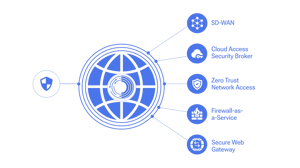
SASE combines five core capabilities, under a shared policy framework:
-
SD-WAN — Routes traffic across available links based on application need, not fixed paths.
-
ZTNA — Replaces broad network access with application-level access, verified by identity and device posture.
-
SWG — Inspects internet-bound traffic against policy at the nearest cloud point, not at a central choke point.
-
CASB — Gives visibility and control over SaaS use, including data that on-premises tools cannot reach.
-
FWaaS — Delivers firewall enforcement from the cloud, across users and locations, without physical appliances.
The policy layer is what turns individual capabilities into a SASE architecture. A single framework applies policies consistently across all enforcement points.
SASE architecture: What the structure actually means
SASE architecture operates across three layers. They work together, not independently, and the way they share a single policy framework is what separates a SASE deployment from a collection of integrated tools.
The connectivity layer is where SD-WAN sits and handles how traffic moves between users, branches, cloud environments and data centres.
The enforcement layer is where ZTNA, SWG, CASB and FWaaS operate, applying security controls at the PoP closest to the user.
The policy layer is the element most often underestimated. It looks like configuration sitting above the other two layers, but it is the architectural element that makes them coherent: one framework that governs how connectivity and enforcement behave across every environment simultaneously. Without it, the components below are tools running in parallel, not an architecture.
How Traffic Flows Through a SASE Environment
Traditional security relies on fixed inspection points. When users work remotely or applications move to the cloud, traffic often bypasses those controls.
SASE takes a different approach. Security is applied at the cloud enforcement point closest to the user, before traffic reaches its destination.
-
Users connect from any location.
-
Traffic is directed to the nearest SASE PoP.
-
Identity and device posture are verified.
-
Security policies are applied.
-
Access is allowed or denied based on policy.
-
SD‑WAN can optimise routing where deployed.
Security enforcement travels with the user rather than waiting at a fixed perimeter. Access is verified and protected at the cloud enforcement point closest to the user.
The Role of Points of Presence
Points of Presence (PoPs) are the distributed cloud locations through which a SASE provider delivers traffic inspection, access control, and routing. Their coverage matters for two reasons that directly affect business outcomes.
-
Performance: Traffic that must travel far to reach an enforcement point before its destination introduces latency. A provider with limited PoP coverage may enforce policy consistently in theory but deliver poor application performance in practice.
-
Policy consistency: If users in certain locations are distant from the nearest PoP, enforcement gaps emerge. Consistent security requires consistent enforcement infrastructure, wherever your users are. Evaluating PoP coverage against your actual user distribution, not a provider's global marketing map, is a practical necessity.
SASE Use Cases: What it looks like in real environments
Consistent security across distributed environments
_____________
Challenge: Security policies are interpreted differently across sites, clouds, users, and regions, creating inconsistent access control, fragmented visibility and higher governance risk.
Solution: A SASE deployment centralises policy across every user, location and cloud environment, so access rules are applied consistently from every enforcement point.
From VPN dependency to zero trust network access
_____________
Challenge: VPN grants users access to the network, not just the application they need. As hybrid teams grow, this creates unnecessary exposure, increases operational overhead and makes access harder to manage securely.
Solution: ZTNA replaces VPN with verified, application-level access based on identity, device posture and policy. For growing businesses without a complex WAN, SSE addresses the core security gap without requiring a full network redesign.
Protecting hybrid workforces wherever they connect
_____________
Challenge: Concentrating security at a fixed network edge fails when most users connect from outside it. Backhauling remote traffic for inspection adds latency without improving protection.
Solution: SASE applies identity-based access, device posture checks, secure web gateway inspection, SaaS visibility and cloud firewall enforcement through cloud points of presence closer to the user.
Regaining complete control over SaaS and Shadow IT
_____________
Challenge: Sensitive data now lives across SaaS apps that on-premises tools cannot inspect. Shadow IT is unknown, unmanaged access and risky data movement often remain hidden.
Solution: A SASE improves SaaS visibility, CASB controls, data protection policies, secure web gateway inspection and cloud-based enforcement together, so organisations can govern sanctioned and unsanctioned app usage more consistently.
Enterprises gain stronger governance, simpler policy management and consistent protection across distributed operations.
Businesses reduce unnecessary network exposure, simplify remote access management and create a more scalable foundation for secure growth.
Consistent access, stronger protection and better application performance from any location.
Enterprises gain stronger governance, simpler policy management and consistent protection across distributed operations.
Building a SASE strategy that fits
your organisation
Identify the gaps driving cost, risk and complexity
Organisations are hardly looking for SASE by name. They are trying to solve practical problems: VPN access that is hard to manage, SaaS usage they cannot fully see, inconsistent policies across locations, rising tool costs or poor application experience for remote users.
The right starting point is not “which SASE platform do we buy?” It is “which gap is creating the most cost, operational or security risk today?” A meaningful assessment focuses on three gaps where SASE delivers the highest return:
Access gap
Where remote access still depends on VPN.
Where access is granted at the network level rather than the application level.
Where compromised credentials would expose far more than the application the user actually needs.
Visibility Gap
Where SaaS use is uninspected.
Where shadow IT is unknown.
Where cloud workloads fall outside existing security controls.
Where internet-bound traffic bypasses inspection.
Policy gap
Where access rules differ across HQ, branches, remote users, and multicloud.
Where policy changes need to be repeated across multiple tools.
Where teams cannot easily prove what is being enforced at what location.
A short supporting check on compliance obligations (traffic inspection, data residency, access event logging) and internal capacity (whether the team can run SASE or needs a managed service from day one) rounds the assessment out.
This assessment does not need to be exhaustive before progress begins, but its outputs should determine what gets deployed and when, not the reverse.
Where enterpirses should begin
For most enterprises, the remote access layer is the logical starting point. Replacing VPN with ZTNA closes a major security gap without requiring changes to the underlying WAN. It is one of the fastest ways to align security with how the workforce operates today.
Where growing businesses should begin
What slows down SASE adoption

Not sure where your organisation sits?
Every environment is different. If you are uncertain which components apply to your current infrastructure,
or you want an independent view of where your most significant security and connectivity gaps are,
Orixcom can assess your environment and provide a clear recommendation, without a predetermined solution in mind.
How Orixcom supports your SASE journey
Orixcom delivers SASE as a managed service that brings connectivity, security, policy and operations into one coordinated model. Rather than deploying isolated tools, Orixcom designs the network and security layers together, so access, inspection, routing and support operate around the customer’s environment. Through trusted partnerships with leading platforms including Cisco and Cloudflare, Orixcom delivers the capabilities organisations need to modernise secure access, protect hybrid workforces, improve SaaS visibility and align connectivity with cloud security requirements.
Map your current environment to identify the right starting point for access, visibility, policy and operational maturity.
Define how access, inspection and enforcement should work across users, devices, applications and locations.
Transition from VPN, legacy controls or fragmented tools seamlessly in stages to reduce disruption and validate progress.
Coordinate implementation across identity, endpoint, security and network environments for a smoother rollout.
Review, refine and optimise policies as users, applications and business requirements change.
Monitor, escalate and support incidents through defined SLAs and a single operational workflow.
SASE centralises policy enforcement, visibility and access governance across distributed environments. This helps reduce operational fragmentation and improve consistency across regions, cloud platforms and remote users.
can simplify integration, policy management and support. Dual-vendor approaches may offer greater flexibility but often require more operational coordination. The right choice depends on existing infrastructure, internal expertise and long-term operating requirements.
SASE projects often struggle because of:
- Undefined access and security policies
- Limited operational ownership
- Siloed networking and security teams
- Rushed migrations from VPN or legacy environments
Useful SASE KPIs often include:
- Improved SaaS and internet visibility
- Faster incident response
- Reduced operational complexity
- Better remote-user experience
- More consistent policy enforcement
- Reduced security risk exposure
The right KPIs depend on the security, operational and connectivity objectives behind the deployment.