CASB within SSE and SASE
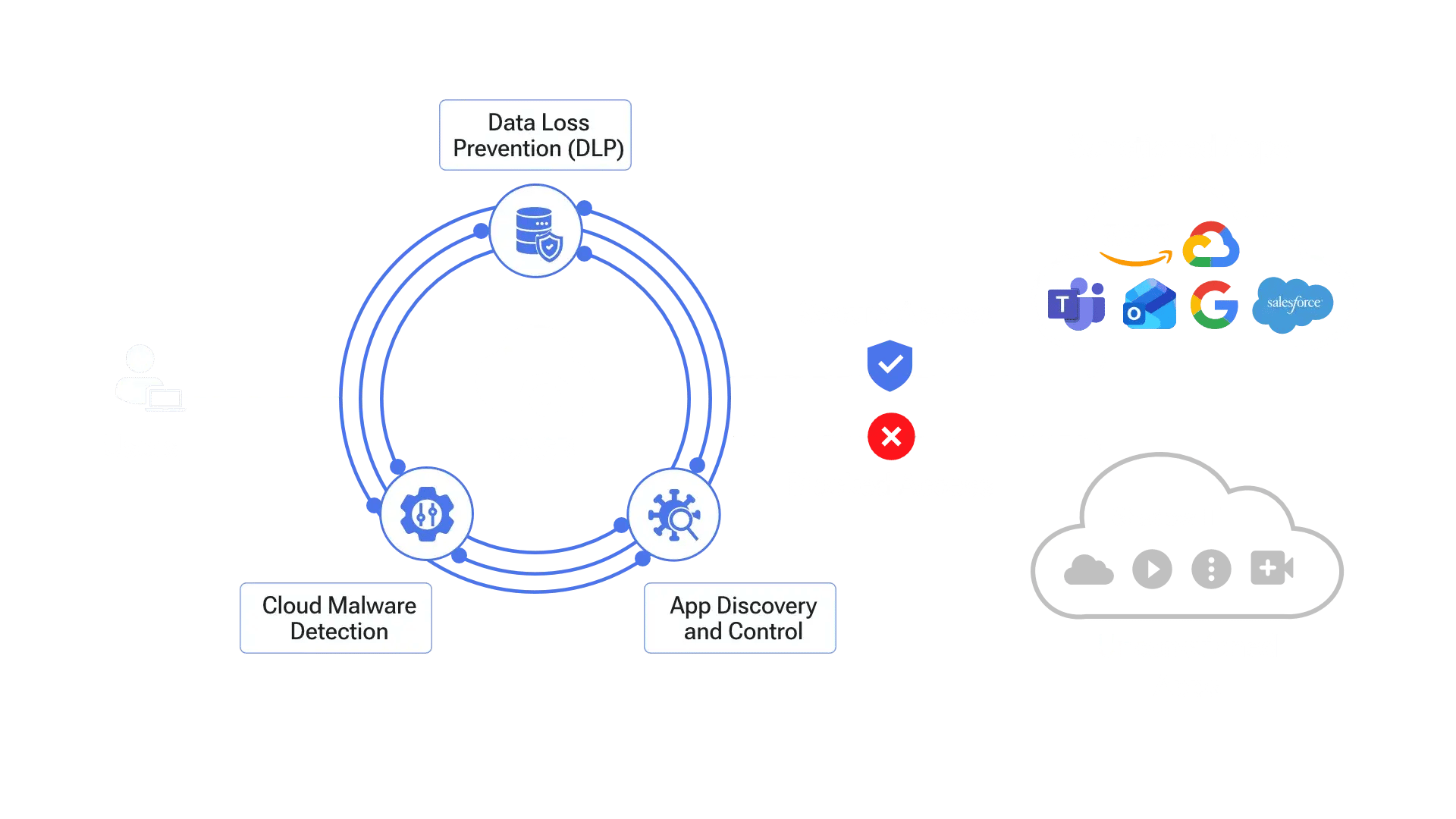
Organisations rarely deploy CASB in isolation. It is most commonly adopted as one of four components within a Security Service Edge (SSE) framework, alongside ZTNA, SWG, and FWaaS, or as part of the security enforcement layer within a complete SASE architecture. Explore our comprehensive SASE Guide to understand how these technologies work together to deliver secure, scalable connectivity.
Within a unified platform, CASB shares policy context with the other components. The identity ZTNA verified, the device posture it assessed, the access decision it made: all of it informs how CASB governs what that user does inside a cloud application. This is what makes CASB more effective as part of an integrated architecture than as a standalone tool.
CASB vs Related Technologies
| SASE Components |
What it does |
How it differs from CASB |
| SWG |
Inspects and filters internet-bound traffic at the connection level |
SWG handles the traffic layer. CASB handles what happens inside the application once the connection is established. Both run together in a properly configured SSE deployment. |
| ZTNA |
Controls whether a user gets access to an application based on identity, device, and context |
ZTNA is the access decision. CASB governs what the user does after access is granted: what data they touch, how they use it, whether their behaviour looks normal. |
| FWaaS |
Controls traffic based on network-level attributes: source, destination, port, protocol |
Firewalls have no visibility into application-layer activity. A user downloading an unusual volume of records from a cloud CRM does not trigger a firewall alert. CASB sees it. |
What to look for when evaluating CASB
Dual-mode operation: Ask whether the solution supports both inline and API modes. If not, ask specifically what gets missed.
SaaS application coverage: Match the provider's supported application library against what your organisation actually uses. The applications that create the most risk in your environment may not be the most common ones on a generic list.
DLP policy depth: Generic classification catches obvious cases. Ask what the capability covers for your specific compliance requirements and data types, not for a feature name on a checklist.
Identity integration: Verify the integration covers all user populations: employees, contractors, partners, and unmanaged device users. Partial integration produces partial visibility.
Platform integration: A CASB requiring separate policy management from the rest of your security stack recreates the fragmentation you are trying to eliminate.
Organisations adopting SSE often find that separate policy engines create unnecessary operational complexity and administration overhead.
How Orixcom delivers CASB
We deliver CASB as part of our fully managed SSE and SASE services, underpinned by Cisco Umbrella technology. As a Cisco Trusted MSSP, we integrate CASB into a unified security framework alongside ZTNA, SWG, and FWaaS, ensuring policies, visibility, and access context are consistent across the entire environment, not fragmented across tools.
For organisations where CASB is the starting point, we begin with discovery. This phase consistently uncovers more cloud usage and risk than expected. From there, we build policies based on real-world activity, not assumptions, giving you immediate, actionable control over your SaaS environment.