How Orixcom ensures seamless cloud-to-cloud connectivity
|

Connectivity

Connecting users,
locations, applications & workloads
Carrier-grade enterprise connectivity solutions that unify usrrs, sites, data centres, clouds, and applications, seamlessly and at scale.
Need help mapping your network journey?
Platform
The Orixcom Platform
Explore an enterprise ready portfolio of products built to support complex business goals and long-term growth.
Need help mapping your Connectivity journey?
SASE
Secure users, devices and
workloads, anytime, anywhere.
Explore an enterprise ready portfolio of products built to support complex business goals and long-term growth.
Need help mapping your SASE journey?
Company
Need more
information?
Our team is always here
to help you, just reach
out anytime.
Support


|

|

|

|

|

|

|
With increasing pressure on enterprise networks to support cloud-first operations, remote workforces, and latency-sensitive applications, SD-WAN has become the preferred alternative to legacy WAN architectures. Its flexibility, cost-effectiveness, and ability to prioritise critical traffic make it a strategic investment for modern businesses. However, while the technology itself is transformative, how it’s deployed is just as critical.
Some organisations opt for a DIY approach, expecting to reduce costs or maintain greater control. Self-deployment often leads to unforeseen complexities—limited visibility, security gaps, and ongoing resource strain on internal IT teams. In contrast, a fully managed service like Orixcom Managed SD-WAN offers not only streamlined deployment but also continuous optimisation, integrated security, and proactive support, removing the operational burden from in-house teams. In this blog, we’ll examine the risks associated with DIY SD-WAN rollouts and explain how Orixcom’s managed service addresses those challenges.
For businesses navigating cloud adoption, hybrid work, and application-heavy environments, SD-WAN has become essential to modern network strategy.
Traditional WAN architectures, often built on MPLS, were not designed for the demands of today’s distributed digital operations. They are expensive to scale, slow to adapt, and lack the visibility needed to manage performance across cloud, branch, and remote environments. This limits agility and creates bottlenecks for cloud-hosted applications, directly affecting user experience and productivity.
SD-WAN addresses these limitations with a more intelligent, software-defined approach to routing and traffic management. It dynamically selects the best-performing path based on real-time network conditions, ensuring optimal application performance across all locations. Its cloud-native design enables seamless access to SaaS, IaaS, and PaaS platforms—eliminating backhauling inefficiencies and reducing latency.
Beyond performance, SD-WAN also offers significant cost advantages. By replacing or augmenting expensive MPLS links with more affordable broadband or LTE options, businesses gain flexibility without compromising on reliability or security. Centralised policy enforcement, integrated security, and simplified orchestration make it easier for IT teams to manage complex, multi-site environments.
However, unlocking these benefits depends heavily on how the solution is deployed, making the choice between DIY and Managed SD-WAN a critical decision.
Talk to a human and discover how Orixcom SD-WAN can improve performance, visibility, and control.
While SD-WAN offers transformative benefits, deploying it without expert support can introduce risks that often negate its advantages. According to multiple reports, 75% of self-deployed SD-WAN projects exceed budget or fail to meet performance goals, primarily due to underestimating complexity and resource requirements. Here’s where most self-deployed SD-WAN initiatives fall short:
Implementing SD-WAN across multiple sites means managing a mix of transport types; MPLS, broadband, LTE, and often dealing with different hardware and software vendors. Without automation or pre-defined templates, enforcing consistent policies becomes time-consuming and error prone. Each site requires manual setup, which slows down rollouts and increases operational overhead.
DIY setups typically lack built-in, enterprise-grade security. Firewalls, intrusion prevention systems (IPS), and DNS-layer protection must be added and managed separately, creating fragmented defences. Without centralised oversight, organisations struggle to maintain consistent threat visibility or timely patching, leaving the network vulnerable to evolving attacks.
A self-managed environment puts significant pressure on internal IT teams. Continuous monitoring, manual troubleshooting, and complex configuration tasks quickly become unsustainable, especially for lean teams. Misconfigurations, common in manual deployments, can lead to degraded performance, downtime, and increased security exposure.
Seamlessly connecting to public cloud providers, legacy systems, and SaaS platforms requires more than basic routing. DIY SD-WAN often lacks automated workflows for multi-cloud environments, making integration cumbersome and inconsistent. Without unified control, enforcing policies across branches and remote users becomes a manual, high-risk process.
These challenges underscore the importance of not just choosing the right SD-WAN technology but deploying it through the right model, one that minimises risk, simplifies operations, and accelerates time to value.
Orixcom Managed SD-WAN is designed to remove the complexity of deployment and day-to-day management while unlocking the full value of a modern network. Here’s how the service delivers to every layer, from infrastructure to cloud.
For more actionable strategies on optimising your network, check out our detailed blog on how to improve network performance. These insights can help you further enhance efficiency and reliabiliy.
The difference between owning SD-WAN hardware and having a fully operational, optimised network lies in how the solution is deployed and supported.
| Feature | DIY SD-WAN | Orixcom Managed SD-WAN |
| Setup Time | Weeks–Months | Pre-configured, ready to deploy |
| Visibility | Limited | 24/7 real-time portal |
| Security | Add-on, fragmented | Built-in, multi-layered |
| Cloud Integration | Manual, inconsistent | Native integration with major CSPs |
| Support | Internal only | End-to-end managed support |
| Total Cost of Ownership | High | Predictable, lower OPEX |
Choosing the DIY path may seem cost-effective upfront, but it often results in delays, integration issues, and significant internal overhead. Setup typically involves configuring multiple vendors, manually establishing policies, and managing compatibility across environments, leading to longer deployment cycles and higher risk of misconfiguration.
Security is also fragmented, requiring separate tools and manual patching, which exposes the network to potential threats. In contrast, Orixcom Managed SD-WAN service is purpose-built to deliver built-in, multi-layered security and seamless integration with leading cloud platforms. Designed and fully operated by Orixcom, with technology partnership with Cisco, the solution ensures optimised performance for applications without manual intervention or operational complexity.
Most importantly, the ongoing cost of internal management, staff time, troubleshooting, and upgrades, adds up quickly. With Orixcom, costs are predictable, outcomes are measurable, and businesses benefit from an always-on network with full visibility and proactive support. It’s not just a deployment model, it’s a smarter, future-ready way to manage your WAN.
Faced with inconsistent network performance and rising connectivity costs across its branches, Al Ghandi Auto Group needed a more scalable, cost-efficient solution. By deploying Orixcom Managed SD-WAN, they gained secure guest access, reduced circuit costs, and established reliable, cloud-ready connectivity across all locations. Centralised control gave their IT team greater visibility and simplified day-to-day network management, freeing up resources to focus on core operations. The result was enhanced user experience for both employees and customers, supporting the company’s digital transformation strategy.
For a media company dependent on real-time broadcasting and regional collaboration, network reliability was business critical. CNBC Arabia turned to Orixcom to upgrade their infrastructure and connect multiple offices and production centres securely. The deployment of Managed SD-WAN significantly reduced latency, improved bandwidth allocation, and provided centralised control over all sites. This enabled seamless video content delivery, uninterrupted editorial workflows, and reliable inter-site communication, ensuring the broadcast operation ran smoothly, even during peak periods.
With a fragmented network and limited visibility across multiple business units, Easa Saleh Al Gurg Group experienced frequent inefficiencies and higher operational overhead. Transitioning to Orixcom’s Managed SD-WAN allowed them to consolidate and optimise bandwidth usage across all sites. The result was a more resilient, high-performance network with better application performance, especially for cloud-based services. Automated policies and central management also enabled the group’s IT team to ensure consistent security and compliance across the board, without manual intervention.
Deploying SD-WAN without expert guidance often leads to more problems than it solves. From complex multi-vendor setups and inconsistent security to limited visibility and overburdened IT teams, DIY deployments carry strategic risks that can impact business performance. These challenges not only delay time-to-value but also increase operational costs and expose networks to vulnerabilities, especially as organisations scale or adopt cloud-first strategies.
As a leading SD-WAN service provider in Dubai, Orixcom eliminates these pain points by delivering a solution that is fully integrated, centrally managed, and built for scale. The service combines advanced performance capabilities with robust security and real-time analytics, strengthened by strategic partnerships with technology leaders like Cisco. But the value goes far beyond the underlying platform. With zero-touch provisioning, dynamic path optimisation, native cloud integration, and around-the-clock support, businesses get a fully managed service that drives real outcomes, higher availability, better user experience, and measurable cost savings.
Ultimately, partnering with Orixcom means more than just deploying SD-WAN, it means building a resilient, cloud-ready network that evolves with your business. You’re not purchasing a product; you’re engaging with a strategic partner who takes ownership of your network performance and security. With deep regional expertise, dedicated customer support, and a future-proof architecture, Orixcom empowers your organisation to grow with confidence.
Q1. Is SD-WAN suitable for all types of businesses?
Yes. SD-WAN is designed to benefit organisations of all sizes, from SMEs to large enterprises, especially those with multiple branches, remote teams, or heavy reliance on cloud applications. Its ability to reduce connectivity costs, improve application performance, and simplify network management makes it suitable across sectors like retail, finance, healthcare, and media.
Q2. What makes managed SD-WAN more secure than a DIY solution?
Managed SD-WAN includes multi-layered security by default, enterprise firewall, IPS, DNS security, and zero trust principles. DIY setups typically require these to be sourced and configured separately, leading to fragmented protection and increased vulnerability. With Orixcom, updates, monitoring, and threat responses are all centrally managed.
Q3. What level of visibility and control does Orixcom offer?
With Orixcom’s 24/7/365 centralised management portal, IT teams have complete real-time visibility into network health, application performance, bandwidth usage, and security metrics. This enables proactive management, quick diagnostics, and data-driven decision-making across all connected sites.
Q4. How quickly can Orixcom deploy its SD-WAN solution?
Orixcom leverages zero-touch provisioning and pre-configured templates, which significantly accelerate deployment timelines. Unlike DIY setups that can take weeks or months, most Orixcom deployments are completed in a fraction of the time, without the need for on-site IT intervention at every location.
Q5. How does SD-WAN improve cloud application performance?
SD-WAN uses real-time path selection and application-aware routing to send cloud traffic over the most efficient paths. Orixcom’s integration with Cisco Cloud OnRamp ensures low-latency, direct-to-cloud access, resulting in faster load times and more consistent performance for apps like Office 365, Salesforce, or Zoom.
|

|
As cloud strategies mature, most enterprises are no longer relying on a single provider. Instead, they’re distributing workloads across multiple clouds to enhance resilience, improve performance, and avoid vendor lock-in. This shift has become the norm rather than the exception.
In fact, 87% of enterprises now operate in a multicloud environment, combining public and private cloud platforms to run critical services (source: Flexera 2024 State of the Cloud Report). While this architecture offers greater control and agility, it also brings new networking challenges, particularly in enabling seamless, secure, and high-performance connectivity between disparate cloud environments.
Conventional methods, such as public internet routing or site-to-site VPNs, introduce latency, increase operational overhead, and lack the visibility required for effective network management. These limitations become more pronounced as it relies on real-time data exchange across providers like AWS, Azure, and Google Cloud.
The growing complexity of multi cloud network connectivity calls for a simpler, more predictable architecture, one that enables direct cloud-to-cloud communication, reduces latency, and scales efficiently with business needs. That’s where solutions like Orixcom CloudConnect are redefining how multicloud networks are built and managed in the Middle East and beyond.
While multicloud adoption continues to accelerate, most businesses still rely on legacy connectivity models that were never designed for inter-cloud performance. These models introduce inefficiencies that limit the very benefits multicloud aims to deliver.
Routing cloud-to-cloud traffic over the public internet often results in unpredictable paths and unnecessary hops, increasing latency and degrading application performance. Site-to-site VPNs might offer basic encryption, but they don’t address performance inconsistency or the limitations of best-effort internet routing. This becomes a major concern for real-time workloads, such as collaboration tools, analytics, or transactional systems, where even minor delays can impact user experience and business outcomes.
With public internet paths and decentralised configurations, visibility across multicloud environments is limited. Network teams lack the end-to-end monitoring and control required for proactive incident response. Moreover, inconsistent security policies across clouds expose the network to misconfigurations, segmentation issues, and compliance risks.
Without a unified, purpose-built framework, traditional multicloud networking not only limits performance and agility but also creates significant barriers to effective multi cloud network connectivity.
87% enterprises now operate
in a multicloud environment.
Don’t get left behind.
Simplifying multicloud networking with Orixcom CloudConnect
Overcoming the limitations of legacy inter-cloud setups requires more than just adding bandwidth, it demands a purpose-built solution designed for multicloud performance, reliability, and control.
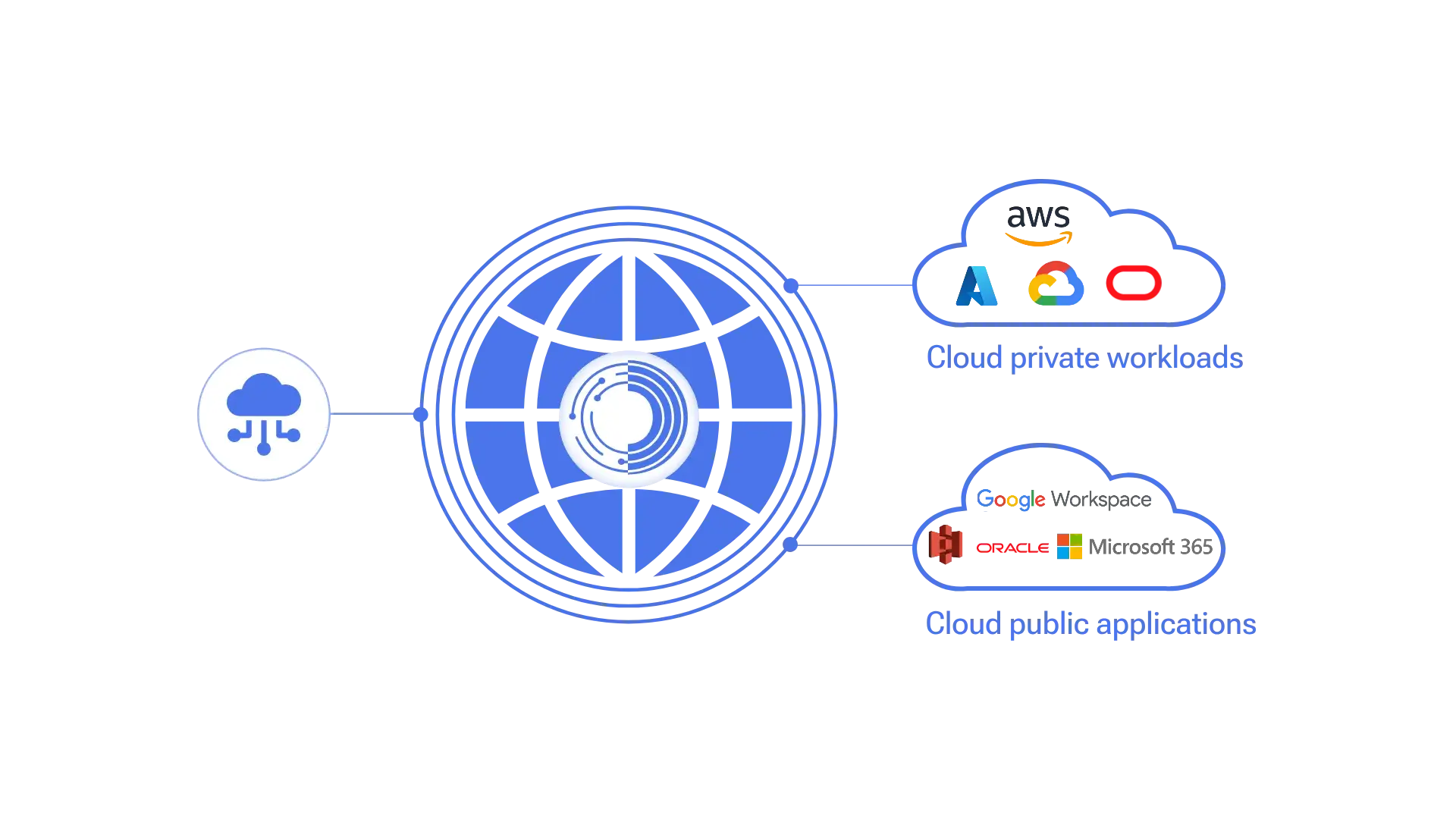
Orixcom CloudConnect is engineered specifically to address the complexities of multi cloud network architecture. It provides enterprises with a dedicated, low-latency pathway between cloud environments, bypassing the unpredictability of the public internet entirely.
Orixcom CloudConnect is built on a streamlined multi cloud network architecture that eliminates the complexity and inefficiency of traditional cloud connectivity models. Instead of managing separate VPNs, on-premises hubs, CloudConnect provides a single, secure interface to interconnect leading cloud service providers (CSPs).
This architecture is engineered for simplicity and control. By consolidating cloud-to-cloud communication into one unified platform, CloudConnect drastically reduces configuration overhead, speeds up provisioning, and offers end-to-end visibility across all connected environments. IT teams can centrally manage policies, monitor performance, and scale connections as needed, without stitching together disparate systems or managing multiple third-party routes.
The result is a robust, scalable, and resilient multi cloud network architecture purpose-built for today’s distributed workloads. Whether supporting real-time applications, cross-region data flows, or multicloud disaster recovery, CloudConnect ensures performance, security, and operational efficiency, by design.
Unlocking the core advantages of Orixcom CloudConnect
To support high-performance applications across distributed cloud environments, enterprises need more than basic connectivity, they need predictable, low-latency, and intelligently managed interconnections between clouds. Orixcom CloudConnect delivers precisely that.
With SLA-backed reliability, flexible bandwidth options, and scalable architecture, Orixcom CloudConnect transforms how organisations build, operate, and scale multicloud networks, bringing control and performance back into the hands of IT teams.
Inside CloudConnect: Architecture for speed, scale & simplicity
What sets CloudConnect apart isn’t just its outcomes, but the robust architecture behind it. Purpose-built to support high-volume, low-latency traffic across cloud environments, its design ensures both scalability and stability at every layer.
Outperforming traditional Internet-based connectivity: The Orixcom Edge
Legacy approaches like VPNs or public internet routing may connect your clouds, but they’re not built for consistent performance, control, or scale. Orixcom CloudConnect delivers a smarter alternative.
Public internet routing introduces unpredictability at every stage. Traffic is handed off between multiple third-party networks, leading to variable latency, packet loss, and reduced reliability. For businesses running latency-sensitive workloads, such as real-time analytics, collaboration platforms, or transactional systems, these inconsistencies can directly impact user experience and business continuity.
VPN-based or hybrid solutions add a layer of encryption but still rely on the same public internet infrastructure. They also struggle to scale in complex multicloud environments, where managing multiple tunnels, policies, and failure points increases both operational effort and the likelihood of misconfigurations. As the number of connected cloud regions and providers grows, so does the complexity, rapidly turning the network into a bottleneck.
In contrast, Orixcom CloudConnect is purpose-built for modern multi cloud network connectivity. It provides direct, SLA-backed interconnectivity between cloud platforms. This results in predictable performance, enhanced security, and simplified network management, at any scale.
Features
Orixcom CloudConnect
Public Internet / VPN-Based Solutions
| Latency | Low and consistent with direct routing | High and variable due to unpredictable paths |
| Performance Stability | SLA-backed with guaranteed bandwidth | Best-effort; subject to congestion and outages |
| Scalability | Point-to-multipoint; easily connects multiple CSPs | Complex to scale with multiple VPNs |
| Security | Built-in encryption and traffic segmentation | Basic encryption; exposed to public network |
| Network Visibility | Centralised monitoring and control | Fragmented visibility across tunnels |
| Operational Efficiency | Simplified, unified management | High overhead with manual setup and maintenance |
With Orixcom CloudConnect, enterprises gain a robust, future-ready foundation for seamless, high-performance multicloud connectivity, without the trade-offs of traditional internet-based models.
Switch to Orixcom CloudConnect.
Who should use CloudConnect?
Not every business needs direct inter-cloud connectivity, but for those that do, performance, control, and simplicity are non-negotiable. That’s where CloudConnect delivers its strongest value.
CloudConnect is best suited for medium to large enterprises operating across AWS, Azure, GCP, and private clouds, particularly in sectors like Fintech, E-commerce, Aviation, Healthcare, and Media. These industries depend on low-latency access, data sovereignty, and uninterrupted cloud performance.
CloudConnect is Ideal for Businesses Running:
For any business seeking optimised multi cloud network connectivity with enhanced operational control, simplified management, and improved user experience, Orixcom CloudConnect offers a proven, scalable solution.
As multicloud adoption becomes the norm, the challenge is no longer just connecting to the cloud, it’s about doing so intelligently. Traditional models built on public internet routing or VPNs may provide basic connectivity, but they fail to meet the demands of today’s distributed, latency-sensitive workloads. To support critical applications and regional expansion, enterprises need a network strategy designed for scale, predictability, and control.
Orixcom CloudConnect addresses these challenges head-on. With its direct cloud-to-cloud interconnection, low-latency routing, and managed service delivery, it simplifies complex architectures while enabling high performance across all environments. Businesses gain the flexibility to deploy across regions, maintain resilience through multicloud disaster recovery, and improve user experience, all without adding complexity to their network operations.
For organisations ready to streamline operations, reduce latency, and future-proof their cloud networking, Orixcom CloudConnect is more than a connectivity solution, it’s a strategic enabler of agility and transformation.
Q1. How does CloudConnect reduce latency in multicloud environments?
Q2. Can I connect multiple cloud regions or CSPs using one CloudConnect solution?
Q3. What makes CloudConnect different from a VPN-based multicloud setup?
Q4. Is CloudConnect suitable for disaster recovery and business continuity strategies?
Q5. Does CloudConnect offer any built-in security features?

|
Internet usage in the digital era is growing at an unprecedented pace. Between 2018 and 2023, global IP traffic more than tripled, reaching over 396 exabytes per month, a clear indicator of how businesses and users increasingly depend on digital services, cloud platforms, and real-time applications. These numbers are only expected to rise. In the Middle Eastern countries alone, a 30% annual increase is expected in traffic across the region by 2027, fuelled by rapid cloud adoption, IoT growth, and digital-first business models. For enterprises in Dubai and the wider GCC, this translates into a pressing demand for faster, more reliable, and scalable connectivity. As regional enterprises scale, the quality of their internet backbone becomes a direct factor in user experience, application performance, and competitive advantage. (Source: Cisco Annual Internet Report)
Yet, many organisations still struggle with high latency, inconsistent performance, and lack of redundancy, especially when accessing global applications and content. These challenges are often worsened by limited local peering options and reliance on single-provider networks.
Positioned within Dubai’s core interconnection hubs: Equinix DX1 and DX3; Orixcom IP Transit delivers the infrastructure required to meet these evolving demands. Backed by extensive local and global peering, carrier-grade uptime, and deep regional expertise, it empowers organisations to optimise internet performance. Let’s explore how Orixcom’s unique approach to IP Transit ensures unmatched reliability and performance.
In a world that runs on uninterrupted digital access, understanding the fundamentals of IP Transit is key to making smarter connectivity decisions and achieving network optimisation. At its core, IP Transit is the service that allows an organisation’s network to access the global internet. This is made possible through the Border Gateway Protocol (BGP), specifically BGP4 for IPv4 and BGP6 for IPv6, which are designed to manage the exchange of routing information between networks. By selecting the most efficient paths for data to travel, BGP plays a central role in network traffic optimisation, directly impacting IP network performance.
A robust IP Transit service connects your network to multiple upstream providers and Internet Exchange Points (IXPs), ensuring high availability, optimal routing, and minimal latency. This directly improves IP network performance, enabling a business in Dubai to reach servers in Frankfurt, users in New York, or cloud platforms in London, without bottlenecks or disruptions.
Without reliable IP Transit, businesses face several factors affecting performance of a network, from high latency and limited peering to single points of failure and bandwidth congestion. These issues often arise with generic internet services or ISPs that lack sufficient regional and global reach.
With the increasing reliance on cloud services, video conferencing, and latency-sensitive applications, enterprises cannot afford subpar internet connectivity. IP Transit provides the foundation for global digital operations, making it an essential element of any serious enterprise network strategy, especially for AS number holders and bandwidth-heavy industries.
Not all data centres are created equal, especially when it comes to IP network performance in the Middle East. That’s where Equinix DX1 and DX3, and Orixcom’s strategic presence within them, become a game changer for network optimisation and regional connectivity.
Equinix DX1 and DX3 are two of the most important carrier-neutral data centres in the UAE, located in Dubai’s Data Centre Capital in IMPZ and DSO respectively. Both facilities are part of Equinix’s global network of over 240 IBX® data centres and offer direct access to over 60+ network service providers within the UAE alone addressing several factors affecting performance of a network, such as route diversity, latency, and resilience.
Orixcom’s infrastructure is deeply embedded within these hubs, enabling it to deliver IP Transit with minimal hops, direct local peering, and optimised paths to international destinations. This setup ensures faster response times and superior internet optimisation, especially for latency-sensitive services like cloud platforms, video conferencing, and digital payments. Proximity to key exchange points also plays a crucial role in network traffic optimisation, preventing congestion and ensuring efficient data flows.
One of Orixcom’s strongest differentiators is its deep regional expertise, operating and supported by robust peering relationships across multiple upstream providers and IXPs. This reduces dependency on distant Tier 1 carriers and strengthens IP network performance at a local level.
Unlock faster, resilient internet connectivity with Orixcom IP Transit

Orixcom’s IP Transit service is engineered to address the most pressing connectivity demands of modern enterprises, offering high availability, performance, and adaptability for evolving network environments.
Orixcom IP Transit is designed to serve diverse business needs, from critical airline operations to latency-sensitive financial services, through a blend of performance, resilience, and flexibility.
Whether supporting mission-critical systems or powering end-user applications, Orixcom IP Transit meets the connectivity demands of modern digital operations.
When every millisecond and packet counts, the difference lies not just in what a provider offers, but in how it delivers it. That’s where Orixcom sets itself apart.
With this combination of global standards and regional intelligence, Orixcom’s solution is ideal for enterprises seeking IP Transit in Dubai.
Unlock cost-effective connectivity today
Discover Orixcom’s flexible and cost-effective IP Transit plans. Contact us for more information!
As the demand for always-on digital services accelerates, internet performance has become a non-negotiable foundation for business success. From cloud adoption and remote collaboration to real-time applications and e-commerce, enterprises today operate in a high-stakes digital environment where latency, packet loss, or downtime directly impact customer experience, operational efficiency, and revenue.
Orixcom’s IP Transit in Dubai addresses these performance challenges with a solution tailored to the realities of the Middle East. Its deployment within Equinix DX1 and DX3, the region’s most strategically located carrier-neutral data centres ensures low-latency, high-availability access to global networks. Combined with extensive peering relationships, IPv6 support, 99.999% SLA, and deep local expertise, Orixcom delivers a carrier-grade, future-ready IP backbone optimised for regional compliance and global reach. The result is a level of resilience, scalability, and control that generic internet services simply cannot match.
For organisations in the UAE and across the GCC, leveraging Orixcom’s IP Transit at Equinix is more than a tactical connectivity choice; it’s a strategic investment in digital continuity and competitive advantage. As network demands continue to grow, businesses need partners who understand global infrastructure with regional expertise.
Q1. What is IP Transit and how is it different from standard internet access?
IP Transit is a service that allows networks to connect to the global internet through upstream providers. Unlike traditional ISP services that often use limited routing and peering, IP Transit offers access to the entire internet routing table, ensuring optimal path selection, lower latency, and high availability. It’s especially suited for businesses with large-scale, global connectivity needs.
Q2. What is the significance of Equinix DX1 and DX3 in Dubai’s connectivity ecosystem?
Equinix DX1 and DX3 are among the UAE’s most interconnected, carrier-neutral data centres, offering access to a wide ecosystem of ISPs, IXPs, and cloud providers. Hosting IP Transit services within these hubs allows Orixcom to deliver fast, direct, and reliable global connectivity.
Q3. How does local peering improve internet performance?
Local peering allows Orixcom to exchange traffic directly with other networks within the region, eliminating unnecessary hops through distant routes. This results in reduced latency, improved load times, and a smoother experience for end users accessing regional or global content.
Q4. Why is IP Transit critical for enterprises in the Middle East?
The Middle East faces unique challenges such as limited local peering, high latency, and dependency on a few major providers. IP Transit from Orixcom, delivered via Equinix DX1 and DX3, offers low-latency, redundant paths and strategic interconnection with global and regional networks, solving many of these pain points.
Q5. What type of support does Orixcom provide with its IP Transit services?
Orixcom offers carrier-grade SLAs, 24/7 network monitoring, and support through a dedicated Network Operations Centre (NOC), ensuring rapid resolution and operational continuity.